Russian Female Names: What Anna, Katya and Sveta Really Tell You
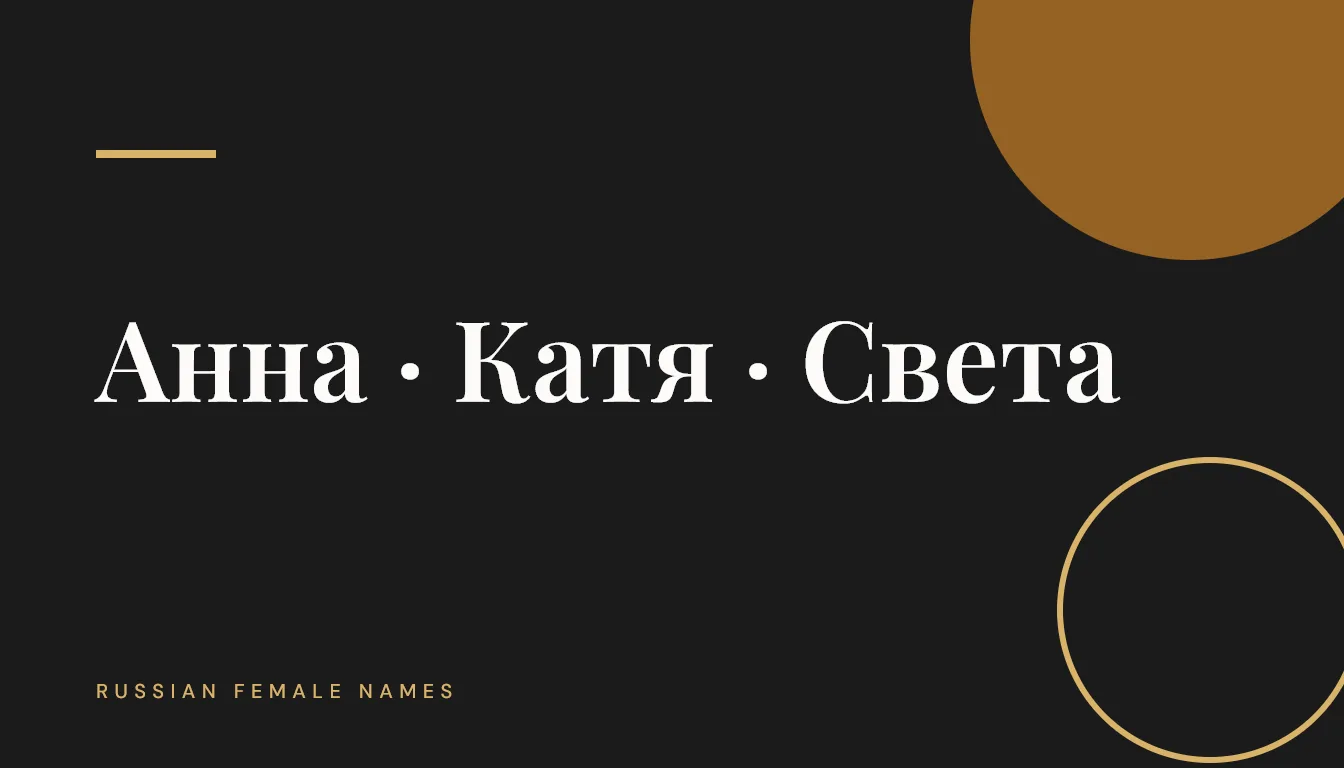
Russian female names follow rules that nobody teaches English speakers, which is why the first weeks of writing to a Russian woman bring the same puzzles. Why does Ekaterina sign her messages Katya? Why does her colleague call her Ekaterina Sergeyevna? Why do so many of the women you meet seem to be called Anna, Elena or Olga? Russian names work in three layers, first name, patronymic and surname, and every first name opens a whole family of nicknames that change with the mood and with the relationship. Here are the names you will actually meet, what they mean, and which form to use, and when.
The names you will meet
The women who join an international agency today were mostly born between 1975 and 1995. Their names are those of that generation, not those of the baby name lists you find online, which describe the girls born last year. The table gives the ten names I see most often, with the everyday form and the origin.
| Name | Everyday form | Origin and meaning |
|---|---|---|
| Anna | Anya | Hebrew, "grace" |
| Ekaterina | Katya | Greek, often read "pure" |
| Elena | Lena | Greek, the name Helen |
| Yulia | Yulya | Latin, the Julius family |
| Olga | Olya | Old Norse Helga, "holy" |
| Natalia | Natasha | Latin, "of Christmas" |
| Anastasia | Nastya | Greek, "resurrection" |
| Maria | Masha | Hebrew, the name Miriam |
| Daria | Dasha | Persian, "holder of good" |
| Svetlana | Sveta | Russian, "light" |
Sources: Russian onomastic dictionaries; frequency observed among the agency's members.
Almost all of them came from Greek, Latin or Hebrew through the Orthodox Church, which for centuries only accepted names taken from its calendar of saints. Olga, brought by the Scandinavian founders of Kievan Rus, and Svetlana, invented in the nineteenth century, are the exceptions.
Three names in one
Every Russian woman carries three names. The first name is hers. The patronymic is formed from her father's first name with the ending -ovna or -evna: the daughter of Sergey is Sergeyevna, the daughter of Andrey is Andreyevna. The surname takes a feminine ending, so the sister of Mr Ivanov is Ms Ivanova, and the sister of Mr Tolstoy is Ms Tolstaya.
The first name and the patronymic together form the polite address. A teacher, a doctor, a manager or an older neighbour is Elena Viktorovna, never "Mrs Petrova". Between partners the patronymic disappears completely, unless it comes back as a joke or as a sign of irritation.
How surnames and patronymics work in detail, including the ones that do not follow the rule, is explained in this guide to Russian first names, surnames and patronymics.
Key takeaway: the patronymic gives away her father's first name. Elena Sergeyevna's father is called Sergey: you know it before anyone introduces you.
From Ekaterina to Katya
This is where most foreigners get lost. Each first name produces a short form, used by everyone who knows her, then a series of tender forms built with suffixes, and finally a form in -ka that sounds offhand, even rude, from an adult.
| Form | Example | When it is used |
|---|---|---|
| Full name | Ekaterina | Documents, first contact |
| Name and patronymic | Ekaterina Sergeyevna | Work, respect, elders |
| Short form | Katya | Friends, colleagues, partner |
| Tender form | Katyusha, Katenka | Family, partner |
| Form in -ka | Katka | Childhood, irritation |
Sources: standard Russian usage; forms in -ka vary by region and by family.
The short form is not always obvious. Aleksandra becomes Sasha, Evgenia becomes Zhenya, Ksenia becomes Ksyusha, and Anna becomes Anya, or Nyura in her great-grandmother's village. Some short forms have even become names in their own right: Alyona, once a folk form of Elena, now appears on birth certificates.
The tender suffixes work like those described in our guide to Russian terms of endearment: -ochka, -enka and -yusha soften a name the way "little" softens a word in English. Lena becomes Lenochka, Sveta becomes Svetochka, Masha becomes Mashenka.
Is your project realistic?
25 questions, 8 minutes, an honest answer. Free, no commitment.
Take the compatibility testNames with a story
Several common names carry a story she will be pleased to hear you know.
- Svetlana is not an ancient Slavic name. The poet Alexander Vostokov invented it in 1802, and Vasily Zhukovsky's ballad Svetlana, published in 1813, made it fashionable. It is built on свет, "light".
- Vera, Nadezhda and Lyubov mean Faith, Hope and Love. They are the names of three martyred sisters whose mother was Sofia, Wisdom, and the four share a name day on 30 September.
- Tatiana has her own national day: 25 January, Saint Tatiana's day, is also Students' Day, because Moscow University was founded by decree on that date in 1755.
- Oktyabrina, Ninel and Vladlena are traces of the Soviet years, when some parents named their daughters after the October revolution or after Lenin, whose name read backwards gives Ninel. They have almost disappeared.
Name days, imeniny, are still marked in many families: the feast of the saint whose name she bears. A message on that day costs nothing, and it is often noticed more than a birthday message, which she receives from everyone.
Key takeaway: ask her when her name day is. Few foreigners know it exists, and the question alone shows that you are interested in her culture, not only in her photos.
The names of today's newborns
The lists of popular Russian girl names that search engines show first describe babies, not adult women. In 2023, Moscow's registry offices gave the name Sofia to 1,981 newborn girls, more than any other; the leading group also included Anna, Maria, Eva, Viktoria, Varvara, Polina, Alisa and Vasilisa. Sofia has been at or near the top in Moscow since 2010.
The fashion is for old names, taken from fairy tales (Vasilisa) or from the nineteenth century (Varvara). The names of the 1970s and 1980s, Elena, Olga, Natalia, Tatiana and Irina, are now the names of mothers.
Russia also counts more than 190 nationalities, and first names show it. Alsu, Guzel and Dinara are Tatar names, which you will hear in Kazan and in Moscow, as our article on Tatar women explains. Madina and Khava are names of the North Caucasus, where family codes are very different, as described in our article on Chechen women. The wider picture of who is Slavic and who is not is set out in our guide to Slavic women.
What I tell the men I accompany
Since 2022 I have helped Western men meet Russian women, and among the members of the agency, Anna, Ekaterina and Elena alone account for about one woman in five. Then come Yulia, Olga, Natalia, Anastasia, Maria, Daria and Svetlana. My advice on names hardly varies:
- use the form she signs with: if she signs Katya, write Katya; if she signs Ekaterina, wait until she switches;
- never call her Natasha as a joke: in the 1990s the name became a crude nickname abroad for any woman from the former Soviet Union, and she knows it;
- do not translate her name: Elena is not Helen and Ekaterina is not Kate;
- learn the stress: ta-TYA-na, na-TA-sha, svet-LA-na; with the stress in the wrong place, the name becomes hard to recognise;
- move to tender forms only after she does: Katyusha from a man she has known for a week sounds forced.
Writing her name in Cyrillic from time to time has its effect too; our guide to learning Russian for your partner explains where to start.
Frequently asked questions
What are the most common Russian female names?
Among women aged 30 to 50: Elena, Olga, Natalia, Tatiana, Ekaterina, Anna, Yulia and Svetlana. Among newborns: Sofia, Anna, Maria, Eva and Alisa.
What is the Russian nickname for Ekaterina?
Katya in everyday use, Katyusha or Katenka as tender forms, and Katka, which sounds offhand from an adult.
Why do Russian women have a middle name?
It is not a middle name but a patronymic, formed from the father's first name: Sergeyevna means daughter of Sergey. Used with the first name, it is the polite way to address someone.
Do Russian women change their surname when they marry?
Most still take their husband's surname, in its feminine form when it is Russian. Russian family law also allows her to keep her own surname or to join both.
Is Svetlana a Slavic name?
It is built on a Slavic root, свет, "light", but a poet invented it in 1802, and it only became widespread in the twentieth century.
In summary
Russian female names rest on a simple system: a first name, a patronymic taken from the father and a surname with a feminine ending. Each first name opens a family of forms, from the formal Ekaterina Sergeyevna to the tender Katyusha. The women you will meet today are mostly called Elena, Olga, Anna or Ekaterina; Sofia and Alisa are their daughters' names. Use the form she uses, learn the stress, and ask about her name day.
You can browse our members' profiles to see the names behind the faces, and if you would like to meet one of these women across a table rather than through a screen, write to me: I answer personally, and I'll tell you honestly whether your plan is realistic.
Ready to meet your future wife?
Take the compatibility test: free, confidential, no commitment.
Test my compatibility