The Karpman Drama Triangle, or Why Your Love Stories Repeat
Do your love stories always end the same way? There is a pattern I watch replay almost every week in the accounts men share with me when they come to the agency: the Karpman drama triangle. Three roles, the victim, the rescuer and the persecutor, that we step into without meaning to and swap around until the relationship burns out. Understanding this drama triangle means putting a name on what has been sabotaging your relationships for years. And more importantly, it means learning how to stay out of it, starting with your very next date.
The Karpman drama triangle in two minutes
The Karpman drama triangle, also called the drama triangle, is a model described in 1968 by Stephen Karpman, an American psychiatrist and a student of Eric Berne, the founder of transactional analysis. The idea fits in a single image: when a relationship starts to sour, the two people take up, without deciding to, three roles placed at the corners of a triangle. The victim, who complains and feels powerless. The rescuer, who rushes to the rescue. The persecutor, who blames and belittles.
What makes the model so powerful is not the description of the roles, it is their movement. No one stays in place. Today's rescuer, tired of giving without return, becomes tomorrow's persecutor. The victim, cornered, fights back and starts blaming in turn. Round and round it goes, the masks change hands, and each person walks away with confirmation of what they already believed: that they give too much, that they are resented, that they will never manage on their own.
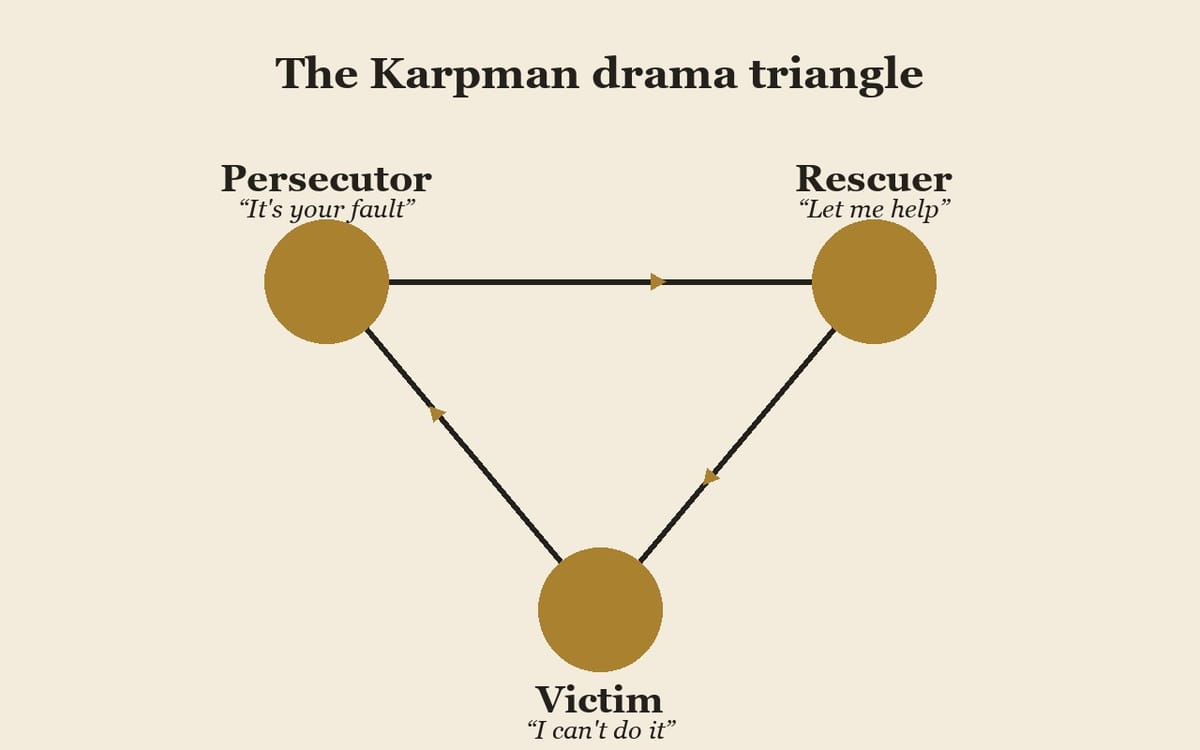
Key takeaway: the Karpman drama triangle is not a story of good guys and bad guys. It is a game with three positions that two people are enough to keep spinning, trading roles without ever stepping out.
The three roles: victim, rescuer, persecutor
Each role has its line, its posture, and a hidden payoff that explains why it is so easy to settle in.
The victim
The victim experiences themselves as overwhelmed by whatever is happening. "I can't do it," "it always happens to me," "no one understands me." They are not looking for a solution, they are looking for someone to take charge. Be careful, this is not a person genuinely wronged by an unfair situation: it is a position one adopts, the stance of someone who refuses their share of responsibility and waits to be rescued. The hidden payoff: nothing to decide, and plenty of attention.
The rescuer
The rescuer rushes in. "Let me help you," "you'd never cope without me." They help without being asked, solve other people's problems, make themselves indispensable. The trap is that their help is not free: it keeps the other person dependent, because a rescuer needs a victim in order to exist. The hidden payoff: feeling useful, superior, loved for what they give rather than for who they are.
The persecutor
The persecutor blames. "It's your fault," "you're useless," "I told you so." They criticize, control and belittle, often with the sincere conviction that they are right. They are not necessarily brutal: the most common persecutor is an exhausted rescuer who can no longer stand giving and finally blows up. The hidden payoff: keeping power, having the last word, never being in the wrong.
| Role | Their line | What they want |
|---|---|---|
| Victim | "I can't do it" | To be taken care of |
| Rescuer | "Let me help" | To feel indispensable |
| Persecutor | "It's your fault" | To keep power |
Why we step into the triangle
We do not step into the triangle by chance, or out of malice. We step in because one of the roles has been familiar to us for a long time. The child who learned to earn love by helping will easily become a rescuing adult. The one who only got attention by struggling keeps the reflex of the victim. These automatisms have their roots in the way we learned, very early, to bond with others, a mechanism I break down in my article on attachment styles.
The triangle also offers a perverse comfort: it spares you real intimacy. As long as you play a role, you never have to show who you truly are. The rescuer never has to say what they need, the victim never has to take a risk, the persecutor never has to admit their fear. Each holds their position because it protects them from the one thing that is genuinely frightening: being seen, and loved without a mask. That is why the triangle survives years of a relationship. It makes no one happy, but it reassures everyone.
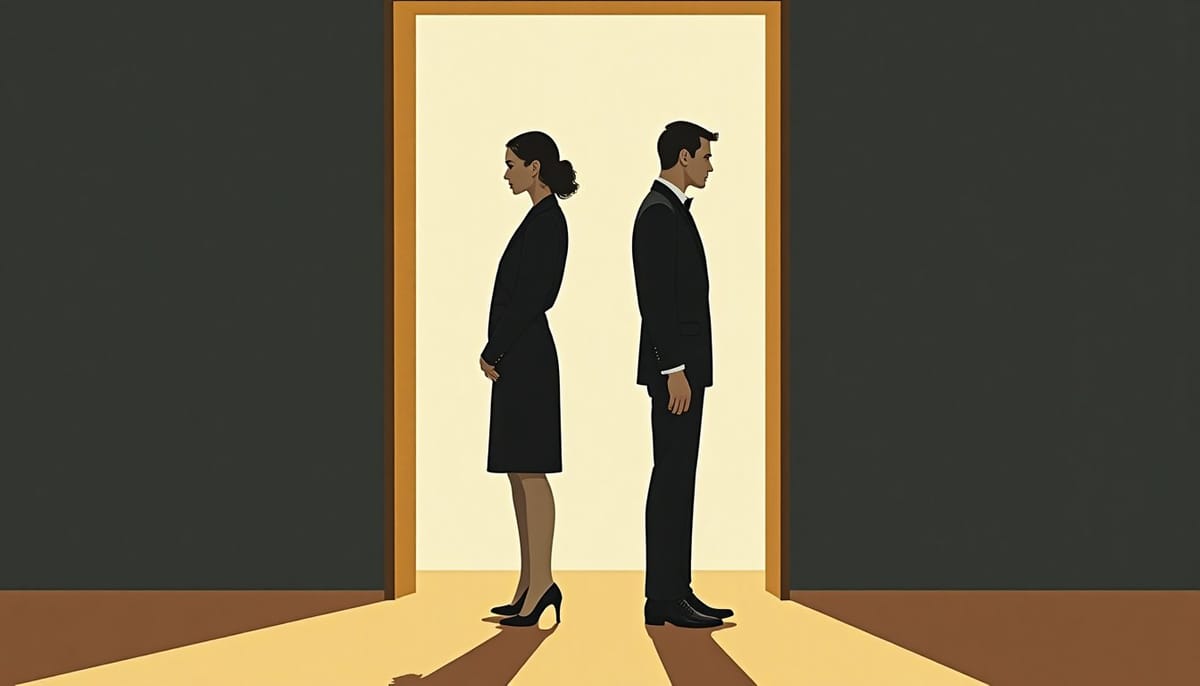
The triangle inside a couple: three typical scenes
On paper this stays abstract. Inside a couple, it produces scenes you may recognize.
The rescuer scene. She is going through a rough patch, he takes charge of everything: her morale, her bills, her decisions. At first she is grateful and he feels enlarged. Then she leans on him more and more, he gives more and more, and one morning he explodes: "I do everything here, and you do nothing." He has just shifted from rescuer to persecutor, and she, accused, slides into the victim. The circle is complete.
The victim scene. He complains endlessly about his job, his tiredness, his bad luck. She comforts, encourages, offers solutions that he bats away one by one. Worn out from carrying someone who refuses to move forward, she finally snaps, sharply, "you're not making any effort." Now she is the persecutor, and he, hurt, sinks a little deeper into his role of the misunderstood victim.
The persecutor scene. One controls, reproaches, corrects constantly, sure they are helping. The other absorbs it, justifies, apologizes, then one day walks out. The persecutor, suddenly alone and helpless, becomes in turn the abandoned victim who cannot understand what is happening. The roles have turned once again.
Key takeaway: in a couple caught in the triangle, no one keeps the same role for long. It is the movement, this constant shift from rescuer to persecutor to victim, that wears the relationship down, far more than the roles themselves.
Is your project realistic?
25 questions, 8 minutes, an honest answer. Free, no commitment.
Take the compatibility testThe triangle from the very first date
Here is what no one talks about: the triangle does not settle in after months of living together, it often forms on the first date. And that is exactly where it can be defused, before it even begins. Since 2022 I have debriefed every meeting the agency arranges, and certain signals come back with striking regularity.
You are being cast as a rescuer if, in the earliest exchanges, the other person rolls out an ex portrayed as a monster, a life made of one emergency after another, permanent chaos told with a certain charm. The implicit message is clear: "I need saving, and you look like you could do it." The rescuer dozing inside you instantly feels useful, wanted, special. That is precisely the moment to slow down.
The mirror exists too. You enter the triangle as the victim when you recite, over the first coffee, your run of romantic bad luck, "I always fall for the wrong people." As the persecutor when you test the other, a little cynical, to see "if she's like all the others." In both cases you are not meeting a person: you are handing out a role. A healthy encounter begins when two adults talk as equals, with neither having to rescue the other. It is also why I insist so much on how to handle a first date without trying to impress or to rescue.
The rescuer syndrome, the male trap
Among the men I work with, the way into the triangle is almost always the same: the rescuer role. It is a flattering role, socially encouraged, that looks deceptively like generosity. The man who systematically chooses women "with problems," who feels alive when he fixes things, who confuses loving with rescuing, is a rescuer who does not know it. And the rescuer always ends up in the same place: exhausted, full of reproach, then left.
This trap takes a particular shape in international dating. The idea of "saving" a woman from the East from a hard life is a rescuer's fantasy, and it is exactly what serious Russian women reject the fastest. They are looking neither for a wallet nor for a first responder, but for a partner on equal footing, a point I develop in my article on what Russian women really expect from a man. The man who shows up as a rescuer disqualifies himself. The one who shows up as an equal, curious and solid, starts with a real head start.
Stepping out: moving to the winner's triangle
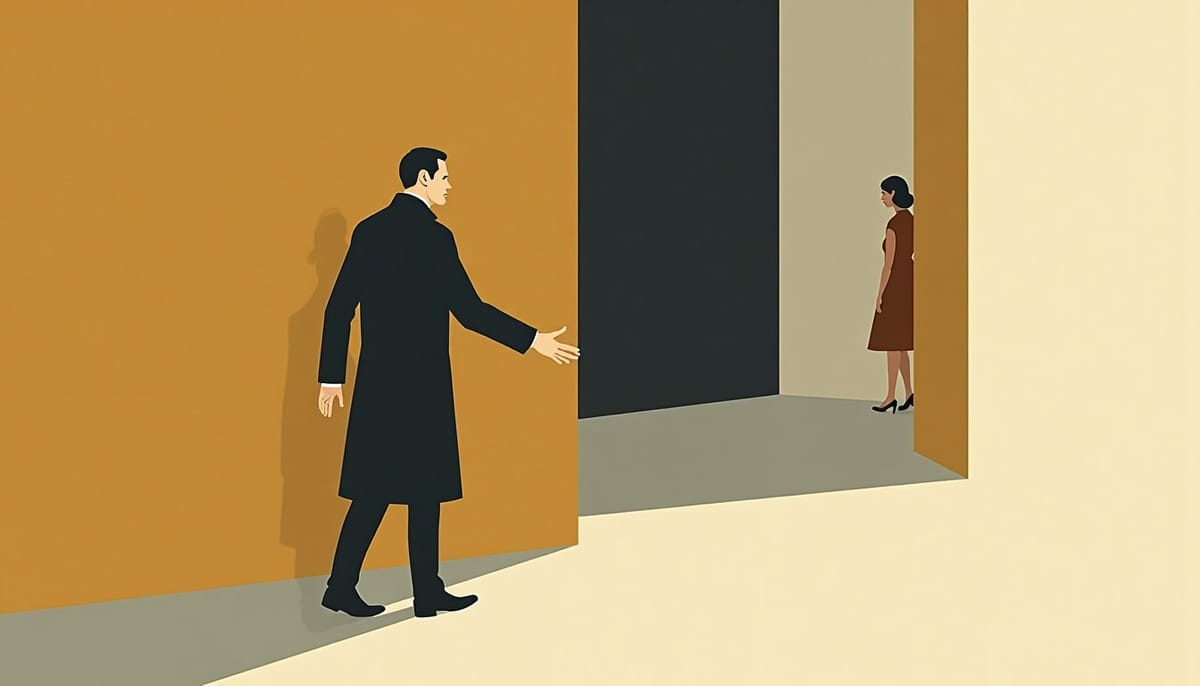
Good news: to each toxic role corresponds a healthy position, and it is often enough to switch from one to the other to defuse the game. This is what coach Acey Choy called the winner's triangle, in the 1990s.
In place of the victim, you become vulnerable but active: instead of waiting to be rescued, you name your problem and clearly ask for help, once, from the right person. In place of the rescuer, you become a caring supporter: you help only when asked, without sacrificing yourself, leaving the other responsible for their own life. In place of the persecutor, you become assertive: you express what is wrong and what you need, without attacking or belittling.
In practice, this comes down to a few sentences that, in love, change everything. Replace "you never do anything" with "I need you to take this on." Replace "leave it, I'll handle it" with "do you want a hand, or would you rather manage it?" Replace "I always end up badly anyway" with "here is what I'm looking for, and what I no longer want." In each case, you drop the role and become again an adult who speaks in their own name. This ability to ask and to set a boundary without attacking is the heart of couple communication that lasts.
Key takeaway: you do not step out of the triangle by changing partners, you step out by changing roles. Active rather than victim, supportive rather than rescuer, assertive rather than persecutor: three shifts, and the game stops for lack of players.
Are you in the triangle? The twelve-sign test
To locate your own tendency, read these twelve statements and count the ones that truly sound like you. They fall into three families of four.
Rescuer side: I often help without being asked; I feel responsible for my partner's happiness; I struggle to say no; I often choose people to fix.
Victim side: I feel I give more than I receive; I wait for the other to guess my needs; I often feel misunderstood or powerless; my relationships always end the same way.
Persecutor side: I readily reproach the other for their shortcomings; I need to have the last word; I criticize when I am disappointed; I test the other to check their intentions.
Three signs or more in a single family point to your preferred role, the one you slide toward when a relationship gets tense. This is not a verdict, it is a map. To go further and see how your pattern meets a partner's, my compatibility test places you in a few minutes, for free. And if your project is to build a lasting relationship, that is exactly the work we do in the agency's support: spotting your automatisms so we can introduce you to people with whom the bond has a chance to hold, free of any triangle.
Frequently asked questions
What are the three roles of the Karpman drama triangle?
The Karpman drama triangle rests on three positions: the victim, who complains and feels powerless; the rescuer, who rushes to the rescue and makes themselves indispensable; the persecutor, who blames and belittles. These roles are not fixed: within a single argument, each shifts from one to another, which keeps the conflict going without ever resolving it.
How do you get out of the Karpman drama triangle as a couple?
You get out by leaving your role, not by changing partners. For the victim, substitute the active person who clearly asks for help; for the rescuer, the supporter who only helps when asked; for the persecutor, the assertive person who states their need without attacking. This is what is called the winner's triangle. The moment one of the two stops playing, the game ends.
What is the rescuer syndrome in love?
The rescuer syndrome is the compulsive need to help and fix the other in order to feel loved and useful. In love, it drives you to choose partners "with problems," to take everything on, then to burn out and slip into reproach. It is the most common way into the triangle, especially among men.
Is the Karpman drama triangle always pathological?
No. We all step into a role from time to time, harmlessly, when we comfort a friend or grumble after a bad day. The triangle becomes a problem when it settles in as a permanent mode of relating, when the roles spin in a loop and neither partner ever feels truly heard.
Ready to meet your future wife?
Take the compatibility test: free, confidential, no commitment.
Test my compatibility