

Can You Marry Multiple Times in the Orthodox Church in Russia?
This question comes up often with the men I work with who are 45 to 55, many of them previously married. The short answer: yes, it's possible. The longer answer requires understanding how the Orthodox Church approaches marriage, differently from what Westerners typically imagine.
– Valentin, depuis MoscouThe question comes up as soon as a divorced man considers an Orthodox wedding with a Russian woman: will the Church agree to marry him a second time? The answer often surprises Catholics, accustomed to the absolute indissolubility of the sacrament. Orthodoxy reasons differently, balancing ideal and compassion, and permits remarriage under conditions and with a modified rite. This article explains that logic, the concrete rules that apply, and what it changes for a couple planning a religious ceremony.
Catholic marriage: an indissoluble sacrament
The Roman Catholic Church considers religious marriage a permanent and indissoluble sacrament. This fundamental principle structures the entire Catholic approach to marriage and has direct consequences for Catholic men considering a union with a Russian Orthodox woman.
Catholic canonical rules
- Only one religious ceremony is permitted during a person's lifetime
- Civil divorce has no canonical significance: the Catholic Church does not recognize divorce
- A second religious marriage requires a formal annulment (declaration of nullity) by an ecclesiastical tribunal
- The annulment procedure takes an average of 12 to 18 months and does not always succeed
- Grounds for annulment are strictly defined: defect of consent, serious psychological immaturity, deliberate exclusion of procreation or fidelity at the time of marriage
Practical consequences
For a divorced Catholic man who wishes to marry a Russian Orthodox woman, this canonical rigidity poses a concrete problem. If he wants a Catholic religious marriage, he must obtain the annulment of his first marriage: a long, costly, and uncertain procedure. This reality pushes some mixed couples to opt for an Orthodox ceremony, which offers a different flexibility.
The Orthodox approach: between ideal and compassion
The Russian Orthodox Church shares the vision of marriage as a sacred mystery (in Greek: mysterion) uniting couples before God. However, it distinguishes itself through a fundamental theological principle: oikonomia.
The principle of oikonomia
Oikonomia (literally "economy" or "household management") is a central theological concept in Orthodoxy. It allows the Church to adapt canonical rigor to difficult human circumstances. It is not moral laxity; it is a pastoral compassion that recognizes human frailty without abandoning the ideal.
Concretely, oikonomia authorizes:
- A second marriage after divorce or death of a spouse, with a simplified procedure
- A third marriage under exceptional circumstances (young children, situation of distress)
- A fourth marriage remains strictly forbidden: no exceptions are granted
This principle rests on the idea that God prefers a remarried and practicing believer to a believer isolated by canonical rigidity. The Orthodox Church considers it preferable to accompany the faithful through their trials rather than exclude them.
Conditions for a second or third marriage
A second Orthodox marriage is not granted automatically. The priest and bishop evaluate the situation according to several criteria:
- The reasons for the divorce: adultery, abandonment of the household, and domestic violence are recognized grounds
- The sincerity of repentance: the candidate for remarriage must express honest reflection on the causes of the previous failure
- The time elapsed: a period of reflection is generally required between the divorce and the new marriage
- Religious practice: regular participation in Church life is expected
For a third marriage, the conditions are considerably stricter. The bishop personally intervenes in the decision, and the circumstances must be truly exceptional.
Orthodox teaching in practice
A well-known Orthodox saying sums up this approach: "The Church blesses the first marriage, celebrates the second, tolerates the third, and forbids the fourth." This tolerance applies to the faithful, not to the clergy: marriage for Orthodox priests follows a much stricter rule, one wife and no remarriage in the Russian Church.

Ritual differences according to the marriage number
Subsequent marriages incorporate significant penitential elements:
First marriage: full ceremony with crowns (ventsy), procession, biblical readings celebrating the ideal union, joyful hymns.
Second marriage: shorter ceremony, penitential prayers added, generally more sober tone. The crowns are maintained but the liturgy includes texts recalling divine mercy and the forgiveness of sins.
Third marriage: significantly reduced ceremony, strong penitential component, absence of certain festive elements. The exceptional nature of this authorization is emphasized throughout the ceremony.
These differences are not punitive. They reflect a theology of humility: each additional marriage is accompanied by a heightened awareness of human fragility and gratitude for divine mercy.
Is your project realistic?
25 questions, 8 minutes, an honest answer. Free, no commitment.
Take the compatibility testCultural significance for Franco-Russian couples
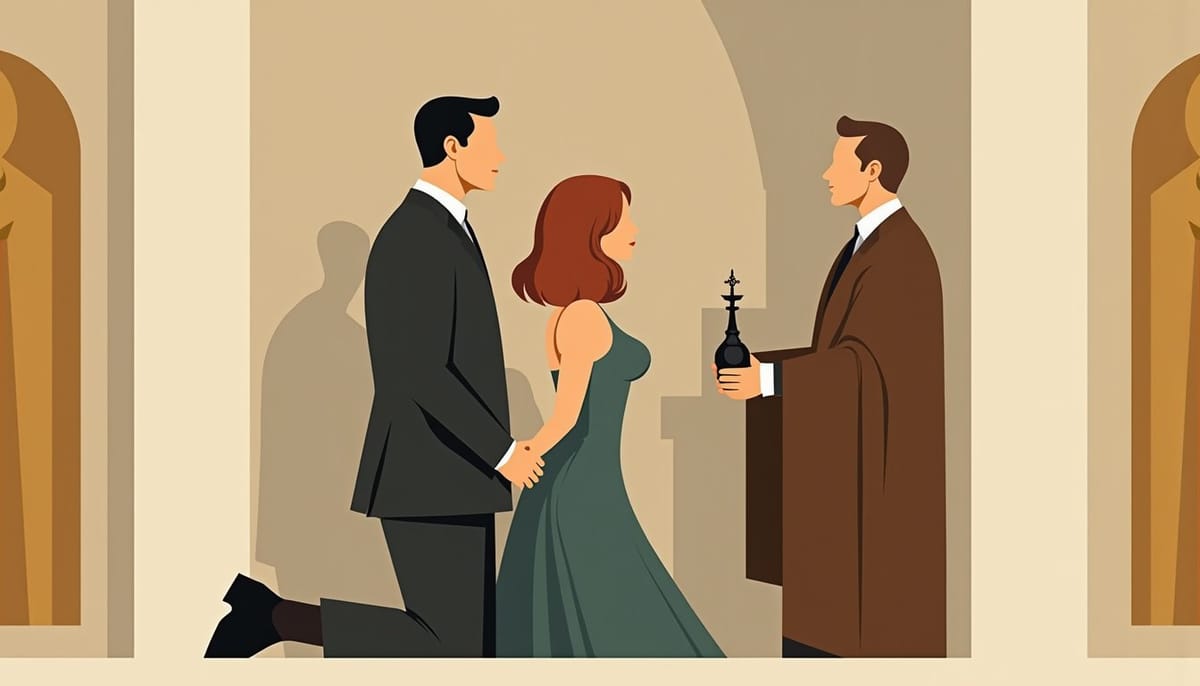
Why this knowledge is indispensable
For a Western man considering marrying a Russian Orthodox woman, understanding these traditions prevents potentially serious misunderstandings. Several concrete scenarios illustrate this importance:
Scenario 1: The man is divorced. In the West, a divorce is a routine procedure. In Russia, if the woman is a believer, she will want to know whether a religious marriage is possible. The Orthodox answer is yes, provided the appropriate procedure is followed. This information can remove a major obstacle in the relationship.
Scenario 2: The woman is divorced. Some Western men worry unnecessarily that a divorced Russian woman is "marked" in her community. Orthodox oikonomia offers a clear and socially accepted path to rehabilitation.
Scenario 3: The couple wants a religious ceremony. A mixed marriage (Catholic-Orthodox) is possible but requires specific authorizations from both Churches. An Orthodox priest can celebrate a marriage where one of the spouses is Catholic, under certain conditions. The article on getting married in church in Russia details the concrete procedures.
Religious marriage in contemporary Russian society
Religious marriage (venchanie) retains a deep cultural significance in Russian society, even among less devout individuals. After decades of atheism imposed by the Soviet regime, the return to religion marked the 1990s and 2000s. Today, approximately 70% of Russians identify as Orthodox, even though regular practice concerns a smaller proportion.
For a Russian woman, a church wedding often represents an additional symbolic commitment beyond the civil marriage. It anchors the union in a thousand-year tradition and confers a sacred dimension that civil marriage alone does not possess. Refusing or ignoring this dimension can be perceived as a lack of respect for her values.
Civil marriage in Russia: the legal framework
It is essential to note that religious marriage has no legal validity in Russia. Only civil marriage, celebrated at the ZAGS (civil registry office), is legally recognized. The couple must therefore go through two ceremonies if they want a complete marriage: civil at the ZAGS and religious at the church.
The civil procedure has its own specificities for foreign nationals: certificate of celibacy, sworn translation of documents, apostille, and in some cases, a 30-day waiting period between filing the application and the ceremony. Understanding the mentality and character of Eastern European women helps navigate these administrative steps with the right approach.
Summary comparison: Catholicism vs Orthodoxy

| Criterion | Catholicism | Orthodoxy |
|---|---|---|
| Number of marriages | 1 only | Up to 3 |
| Divorce recognized | No | Yes (under conditions) |
| Remarriage possible | After annulment only | After recognized divorce |
| Guiding principle | Absolute indissolubility | Oikonomia (compassion) |
| Remarriage ceremony | Identical to the first | Penitential elements added |
Conclusion: knowledge that changes everything
The difference between the Catholic and Orthodox approach to marriage is not an abstract theological detail. It is a practical reality that directly influences the life plans of Franco-Russian couples. An informed man avoids misunderstandings, reassures his partner, and demonstrates authentic respect for her culture.
Discover our support services to be guided through every step of your intercultural couple project, including the religious and administrative aspects of marriage in Russia.
Ready to meet your future wife?
Take the compatibility test: free, confidential, no commitment.
Test my compatibility