
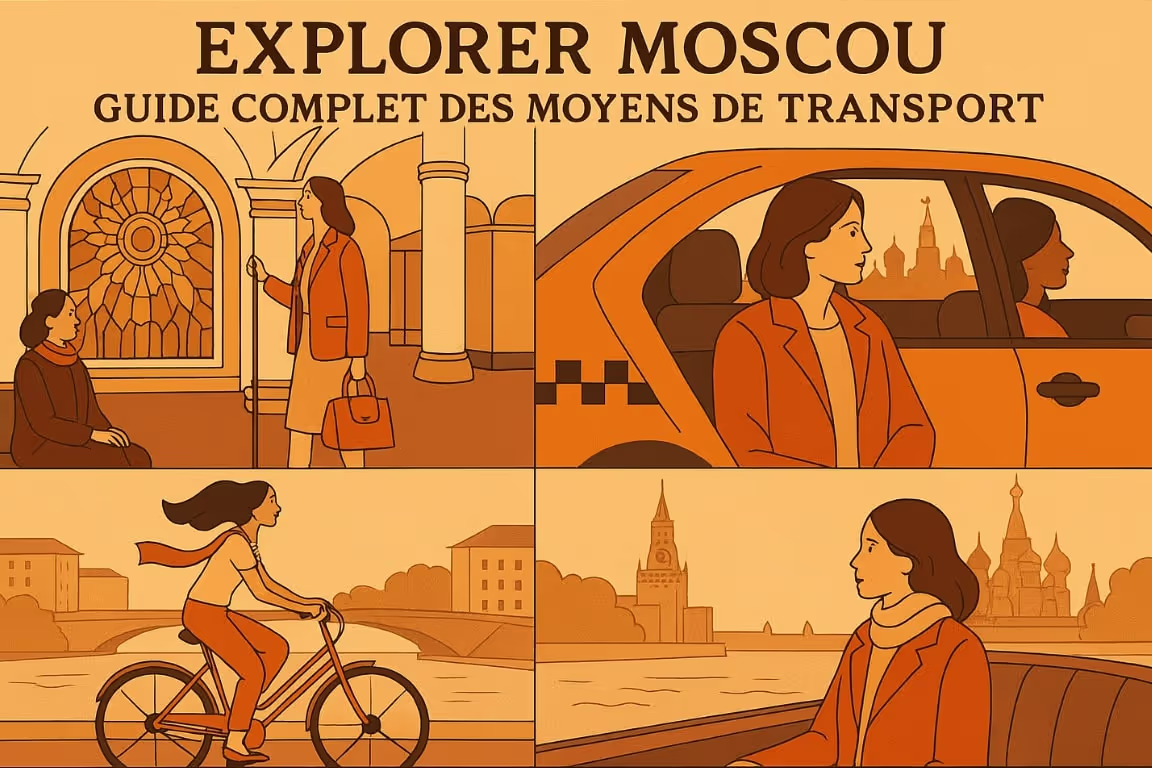
Transportation in Moscow: A Complete Guide
Why mastering Moscow's transportation is strategic
Moscow is a megalopolis of 13 million inhabitants spread across more than 2,500 km². For a Western man traveling there as part of a relationship project, mastering transportation directly determines the quality of his stay. Arriving late to a date, getting lost between stations, or paying three times the normal fare sends a signal of unpreparedness that Russian women pick up on immediately.
This guide covers all available means of transportation in Moscow, with practical, pricing, and strategic information so your stay proceeds without logistical friction. If you are preparing a first trip to Russia, this information is essential.
The Moscow metro: backbone of the network
An exceptional network
The Moscow metro is the fourth busiest in the world, carrying over 6 million passengers daily. It operates from 05:30 to 01:00 and covers nearly the entire city with its 15 lines and more than 250 stations. Peak-hour frequency drops below 90 seconds between trains, making it the most reliable means of transportation in the capital.
For a Frenchman accustomed to the Paris metro, the Moscow network impresses with its cleanliness, punctuality, and depth. Some stations descend more than 80 meters underground — a Cold War legacy that also designed them to serve as shelters.
The Troika card: essential
The Troika card is the rechargeable pass that provides access to all of Moscow's public transportation. The fare per trip is approximately 46 RUB (about 0.45 EUR). You can buy it at any metro station and reload it at automated terminals or via the app. Top priority: get one as soon as you arrive at the airport or at your first station.
Must-see stations
The Moscow metro is an underground art gallery that few cities in the world can rival:
- Komsomolskaya — vaulted ceilings adorned with monumental historical mosaics
- Ploshchad Revolyutsii — 76 bronze statues representing the Soviet people
- Taganskaya — majolica panels paying tribute to war heroes
- Novoslobodskaya — 32 colorful stained-glass windows reminiscent of a cathedral
- Mayakovskaya — Art Deco mosaics and indirect lighting, considered one of the most beautiful stations in the world
Visiting these stations outside of rush hours is a cultural activity in its own right — and an excellent conversation topic during a date.
Buses, trolleybuses, and trams: surface networks
Buses and trolleybuses
Moscow's surface network covers areas poorly served by the metro. Buses and trolleybuses run from 05:30 to 01:00 and accept the Troika card. Fares are identical to metro fares. The main drawback remains heavy urban traffic: during rush hours, a 5 km trip can take 40 minutes.
The Yandex Transport app (or Yandex Maps) provides real-time tracking of each vehicle. It is available in English and displays wait times, routes, and connections. It is an essential tool for navigating the surface network.
Trams
Trams offer a peaceful and picturesque means of transportation through outlying neighborhoods. They are particularly useful in southern and eastern Moscow. The network has been modernized with new air-conditioned trams. Trams run on dedicated tracks, which often makes them faster than buses during rush hours.
Marshrutkas: shared minibuses
Marshrutkas are private minibuses that follow fixed routes but stop on demand. Fares are comparable to standard buses. They are fast and direct, but comfort is minimal and the driving style can be aggressive. Useful for specific trips to the suburbs, but not recommended for first-time visitors.
Taxis and ride-hailing: the most comfortable option
Yandex Go: the essential app
Forget street taxis — they charge arbitrary fares and pose a risk for foreigners. The Yandex Go app (Russia's equivalent of Uber) is the absolute reference:
- Transparent pricing calculated before the ride
- Central trips: 300-500 RUB (3-5 EUR) on average
- Real-time GPS tracking
- Payment by card (including MIR cards) or cash
- Several categories: Economy, Comfort, Comfort+, Business
For an important date, the Comfort+ category offers a recent vehicle with a professional driver for a modest surcharge. It is an investment that makes a good impression.
Practical tips for ride-hailing
A few things to keep in mind: Yandex Go drivers rarely speak French or English. Have the destination address written in Cyrillic or share it via the app. Tips are not mandatory but appreciated (10-15%). In case of problems, the app's customer support is responsive.
Airport-to-city-center transportation
Moscow has three main airports: Sheremetyevo (SVO), Domodedovo (DME), and Vnukovo (VKO). To reach the city center from each:
- Aeroexpress: fast train connecting each airport to the center in 35-50 minutes. Fare: approximately 500 RUB. Comfortable, punctual, recommended.
- Yandex Go: 1,500-3,000 RUB depending on traffic and the airport. Allow 60-120 minutes depending on the time.
- Public buses: the cheapest option (100-200 RUB) but the slowest and most complex.
The optimal strategy for a first trip: Aeroexpress to the terminus station, then metro or Yandex Go to the hotel. It is the best compromise between cost, reliability, and simplicity.
Alternative transportation and leisure
Bike sharing
The Velobike system provides 2,700 bicycles across more than 300 stations throughout the city. The daily rate is approximately 150 RUB. Bike lanes have expanded considerably in recent years, particularly along the Moskva River and in central parks.
Electric scooters
Several operators (Whoosh, Yandex Go, Urent) offer shared electric scooters. Fare: 50 RUB to unlock + 5-10 RUB per minute. Practical for short distances in the center, but be careful: Moscow traffic is dense and unpredictable.
Moskva River cruises
River cruises offer a unique perspective of the city. Prices vary considerably:
- Standard tourist cruise: 650-1,500 RUB
- Dinner cruise: 3,000-8,000 RUB
- Private event rental: up to 200,000 RUB
An evening cruise makes for an original date activity. The view of the illuminated Kremlin from the Moskva River is spectacular.
Driving in Moscow: strongly discouraged
Renting a car in Moscow is a bad idea disguised as a good one, for several concrete reasons:
- Chronic traffic jams: Moscow regularly ranks among the top 5 most congested cities worldwide
- Limited and expensive parking in the center (up to 380 RUB/hour in some zones)
- Aggressive driving from local motorists
- Cyrillic signage that is difficult to decipher
- Frequent police checks for rental vehicles
The public transportation network combined with Yandex Go covers 100% of a foreign visitor's needs. A car provides no advantage and plenty of stress.
Specific tips for a dating trip
When you come to Moscow as part of support from the Valentin agency, certain logistical considerations deserve attention:
For your dates: always allow a 15-20 minute margin. Russian women are generally punctual and expect the same rigor from you. Use Yandex Go for evening dates — arriving by ride-hailing rather than metro makes a better impression.
For your daily travel: the metro remains unbeatable during the day. Download Yandex Maps (which works offline) and the Moscow metro app. Both are available in English.
For excursions: if you wish to visit the surroundings (Sergiev Posad, the imperial estates), suburban trains depart from central stations. The agency can organize these trips for you as part of its comprehensive support.
Knowledge of the terrain is a concrete asset in your relationship project. A man who moves confidently through Moscow demonstrates that he takes his commitment seriously. To learn more about trip preparation, consult our guide to mistakes to avoid in Eastern Europe.
Moscow transportation cost summary
| Mode of transportation | Average cost | Recommendation | |---|---|---| | Metro (Troika) | 46 RUB/trip | Priority | | Bus/Trolleybus | 46 RUB/trip | Complementary | | Yandex Go Economy | 300-500 RUB | Dates, evenings | | Yandex Go Comfort+ | 500-900 RUB | Special occasions | | Aeroexpress | 500 RUB | Airport only | | Velobike | 150 RUB/day | Leisure, nice weather | | Moskva River cruise | 650-8,000 RUB | Date activity |
A reasonable daily transportation budget for a week-long stay is between 500 and 1,500 RUB per day (5-15 EUR), which remains very affordable for a European. Russia offers favorable purchasing power for Western visitors, and transportation is a direct illustration of this.
Discover our members to begin your relationship project, and take the compatibility test to assess your profile before planning your first trip.
Ready to take the first step?
Start with a Diagnostic: a 1-hour consultation with the agency director to assess whether your project is realistic.
Book my Diagnostic — $99